

Ever wonder how a wall can transform a room just by shifting its position? Non-load bearing wall framing lets you change your space without the extra work needed for load-bearing walls. In this post, we cover three practical ways to build lightweight partitions. You’ll see how using simple materials and easy techniques makes it simple to move doors, windows, and ducts as your needs change. Get ready to update your home with design ideas that keep things simple, cost-effective, and stress-free.
Understanding Non Structural Partition Framing: Fundamentals

Non load bearing wall framing splits interior spaces without holding up the ceiling or roof. These walls support only their own weight while neatly dividing a room. Unlike load-bearing walls that use special headers (pre-calculated beams per IRC Header Span Tables) to carry extra weight, nonstructural walls use a simpler design. Think of it like a room divider that doesn’t hold up the roof, you get flexibility without heavy materials.
Even though these walls don’t carry loads, you still need to plan carefully. Consider where doors, windows, plumbing, and ducts will go. Many homeowners find that non load bearing walls are easy to change later, like rearranging furniture in a living room. This flexibility makes them a smart choice if you want to update a space later without major work.
When you compare structural and nonstructural framing, non load bearing walls are easier to build with lower labor and material costs. They work well for spaces such as playrooms, offices, or closets, keeping the project simple, efficient, and budget-friendly.
Essential Materials and Tools for Non Load Bearing Wall Construction

For a successful non load bearing wall build, using the right supplies and tools is key. Start with good quality standard lumber such as 2×4 studs and top/bottom plates (2×4 means actual 1.5 in x 3.5 in / 38 mm x 89 mm). These pieces make up your wall and must be straight. Next, choose a sheathing like 1/2 in (12.7 mm) OSB or 1/2 in gypsum board to cover the frame and serve as the base for your finish work. Use temporary diagonal 2×4 supports to keep the wall plumb until you add the final sheathing. Fasteners such as 16d nails or 3 in (76 mm) framing screws secure the studs to the plates and attach the braces. Finally, get reliable tools like a framing nailer, a circular saw for precise cuts, a level for accuracy, a chalk line for marking straight lines, and a speed square to check right angles.
| Material | Typical Dimension | Purpose |
|---|---|---|
| Lumber | 2×4 (studs and plates) | Frame structure |
| Sheathing | 1/2 in OSB or gypsum board | Provides a surface base |
| Temporary Bracing | 2×4 | Keeps wall plumb during assembly |
| Fasteners | 16d nails or 3 in screws | Secure the framing members |
| Tools | Nailer, circular saw, level, chalk line, speed square | Help with precise cuts and layout |
3 non load bearing wall framing: DIY success
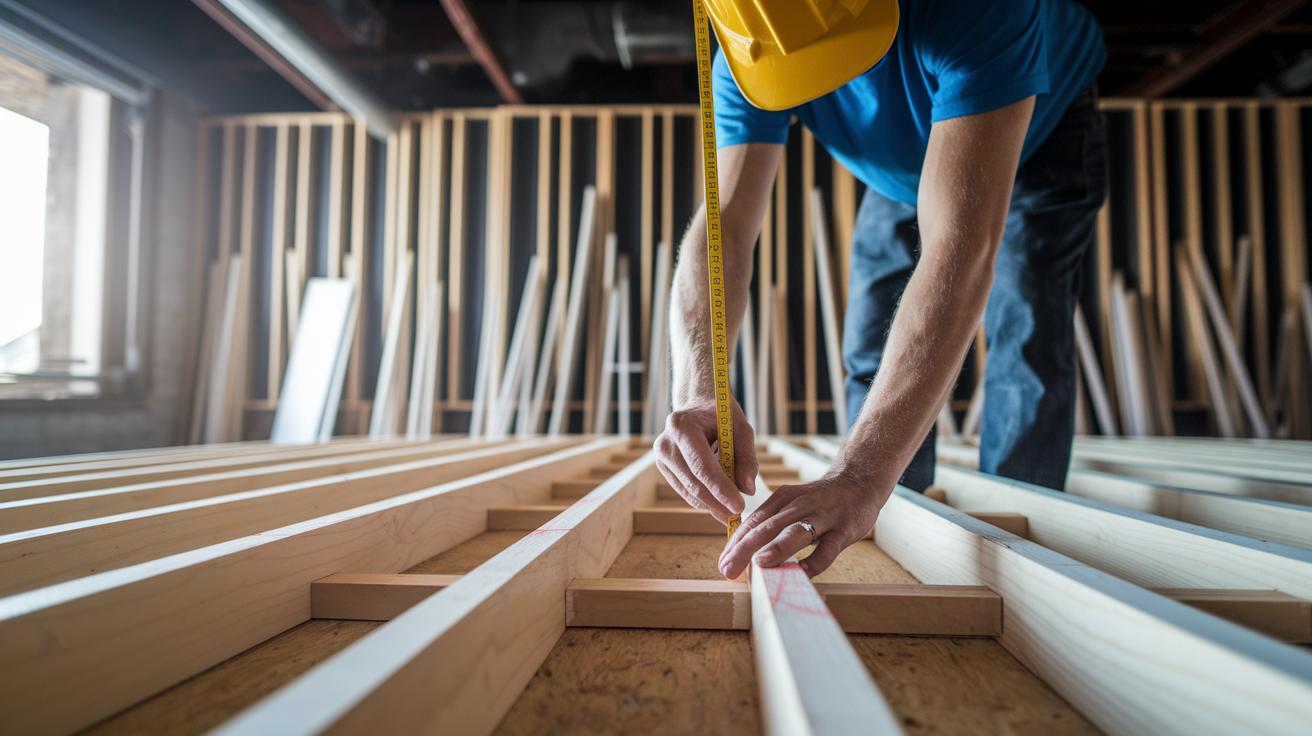
Start by marking your top and bottom plates carefully. Measure 15¼ inches (38.7 cm) from one end to set the first stud spot, then mark every 16 inches (40.6 cm) along the plate. Run a chalk line on both plates to make sure your marks are straight, just like drawing a neat line on a freshly painted floor.
When you get ready for door and window openings, add extra marks for jack studs (short supports for the header) and king studs (full-length studs on the edge). Measure these spaces carefully so your door jambs or window units will fit right. Double-check your work to steer clear of misalignment and wasted parts.
Lastly, grab a speed square to check that your marks are plumb. This keeps your studs aligned and makes nailing and fastening easier. Proper stud placement ensures your wall stays stable and finishes go on smoothly.
Step-by-Step Guide to Assembling and Erecting Non Structural Wall Frames

-
Start on a flat work surface. Lay out your top and bottom plates with all your studs. Mark a point 15¼ inches (38.7 cm) from one end of each plate and then mark every 16 inches (40.6 cm) along the plate to show where each stud will go.
-
Cut your lumber to match these marks. Accurate cuts help everything fit together as planned.
-
Place each stud against the mark on the plate. Fasten them with a framing nailer by driving 2 to 3 nails into the end of each stud. This step secures your frame right from the start.
-
After the frame is built on the ground, lift it carefully and position it under the ceiling joists (horizontal beams that support the ceiling). Check with a level to make sure the frame is plumb (vertically true) and level. The frame should line up with your pre-marked points.
-
Install temporary diagonal braces made from 2×4 (actual 1.5 in x 3.5 in / 38 mm x 89 mm) pieces along the inside of the frame. These braces hold the wall square until you attach the final sheathing.
-
Double-check that every stud is aligned and the frame is stable. If the pocket-hole method (a fastener technique using angled holes) seems shaky, toenail the studs to the plates by driving nails at an angle for extra support.
By following these steps, you build a non-structural wall that lines up correctly and stays stable until you finish the wall covering. Always work safely and take your time for the best results.
Framing Door and Window Openings in Non Load Bearing Walls

For door openings, start by marking where your studs will go. Place a full-length king stud on each side of the opening. Next, add a jack stud beside the king stud on the header side. Use a header made from two 2x4s (actual 1.5 in x 3.5 in / 38 mm x 89 mm) cut to the exact width of your rough opening. This method works well for non load bearing walls, where heavy loads aren’t a concern. For example, when framing a door, line up your studs carefully and use the pair of 2x4s for a neat header that fits indoor doorways. This simple setup means you can skip the ½-inch plywood spacer that load-bearing walls need, while still getting a clean finish.
For window openings, pay close attention to extra details. In addition to the king and jack studs on the sides, add cripple studs above the header to complete the frame. Place a sill plate under the rough opening to support the window unit. Use a minimal header made from two 2x4s sized to the window’s dimensions. This structure holds the opening securely for non load bearing walls and keeps the window sash aligned properly. Quick tip: always double-check your measurements because a small error in the header can make window installation tricky.
| Rough Opening Width | Header Assembly Style |
|---|---|
| 30 in (76 cm) | Double 2×4 minimal header |
| 36 in (91 cm) | Double 2×4 minimal header |
| 42 in (107 cm) | Double 2×4 minimal header |
Compliance, Stability, and Performance Best Practices in Partition Framing

Make sure every non load bearing wall frame meets your local building codes. When you attach the bottom plate to concrete or a floor system, follow the rules for plate anchoring. For example, if the code calls for a concrete tie-down, fasten the bottom plate securely using the correct hardware.
After you build the frame, add a double top plate to join adjoining partitions. This makes the wall stiffer and helps spread loads evenly. Use a framing nailer or screws as you would for a load-bearing wall.
Keep temporary diagonal 2×4 braces (2×4 means lumber that is nominally 2 inches by 4 inches, actual 1.5 in x 3.5 in / 38 mm x 89 mm) in place until your OSB or drywall is fully secured. These braces help keep the wall plumb and square during installation. As a safety check, drill utility holes per code guidelines. The holes should be no bigger than 40% of the stud’s width to protect the fire rating and the wall’s strength.
Follow these steps closely, and your partition will be safe, solid, and ready for inspection.
Final Words
In the action, we walked through the basics of non load bearing wall framing. We covered material selection, layout standards, careful assembly, and framing openings for doors and windows. You learned how to tackle each step while keeping safety and code compliance in mind.
Take these insights into your next project. With clear steps and smart planning, your home renovation journey will be safe, efficient, and cost-effective. Enjoy the process and build with confidence.
FAQ
What does non load bearing wall framing span refer to?
The non load bearing wall framing span refers to the distance the wall covers while supporting only its own weight, typically built with studs placed 16 in (406 mm) on center for stability.
What are common examples and design features of interior non load bearing walls?
Common examples include room dividers, closet walls, or partitions that separate spaces. They’re designed using lightweight materials like 2×4 studs without engineered headers since they don’t support floors or roofs.
What information does a non load bearing wall framing diagram provide?
A non load bearing wall framing diagram details stud placement, top and bottom plates, and any required temporary bracing. It visually explains the layout used to construct interior partitions safely and accurately.
How does non load bearing wall design differ from load bearing wall design?
Non load bearing wall design differs as it supports only its own weight, requiring simpler framing. In contrast, load bearing walls must carry additional loads from ceilings or roofs and need engineered headers and reinforced construction.
How do you build a non load bearing wall on concrete?
Building a non load bearing wall on concrete involves anchoring the bottom plate securely, using appropriate fasteners, aligning studs at correct spacing, and adding temporary bracing until the wall is fully sheathed.
What type of header is needed for a non load bearing wall, and is a header required?
For non load bearing walls with door or window openings, a minimal header—often a double 2×4—is required to frame the opening. It is not load rated, as these walls only support their own weight.
What is the maximum stud spacing for a non load-bearing wall?
The maximum stud spacing for a non load-bearing wall is typically 16 in (406 mm) on center, ensuring that the framing remains stable and supports finishes like drywall effectively.
Do non load bearing walls need studs, and how are they supported?
Non load bearing walls need studs to form a frame for insulation, wiring, and wall coverings. They are supported with temporary bracing during installation and secured using nails or screws along with properly anchored plates.