

Ever notice how some drywall projects turn out solid while others soon show cracks? A small mistake in your measurements or cuts can waste panels and invite extra work. This guide walks you through each step to help you build walls that remain strong and tidy. Check your tools and plan every cut to avoid common errors, save time, and keep costs down. Follow these steps to achieve a finish that lasts.
3. drywall installation steps for flawless results

Start your drywall project by following a clear, step-by-step process. Each stage is important to make sure your wall looks neat and stays strong over time. Even a small mistake in measuring can cost you extra work and wasted panels.
Before you begin, check that you have all the right tools and review your plans. You’ll need a T-square, a utility knife, and a spiral saw (a saw with a coiled blade) for clean, precise cuts. Keeping your work area tidy and following proper spacing guidelines helps you avoid common errors and saves time.
- Measure and cut the drywall sheets: First, calculate the total wall square footage. For 4×8 sheets, divide by 32; for 4×12 sheets, divide by 48. Mark the panels and cut them to fit.
- Position the top panel and secure its corners: Hang the first sheet horizontally in the upper corner and nail all four corners to hold it in place.
- Fasten with screws at the right spacing: Attach the sheet to the studs using 1¼ in (3.2 cm) screws placed about 16 in (40.6 cm) apart from the center of each stud. You can adjust for larger sheets if needed.
- Leave a ½ in (1.3 cm) gap at the floor: Keep a half-inch gap between the bottom edge of the sheet and the floor to allow for natural expansion. This gap will later be covered by a baseboard.
- Cut openings after switching off power: Always shut off the circuits before cutting out spaces for windows, doors, or fixtures. Use the spiral saw for accurate cuts.
- Install corner beads and clean up the corners: Overlap the panels at the corners and attach metal or vinyl corner beads. Smooth off any excess material using a drywall rasp (a file for smoothing drywall edges).
By taking accurate measurements and fastening properly at each step, you’ll achieve a durable finish that looks professional and lasts.
Essential Tools and Materials for Drywall Installation
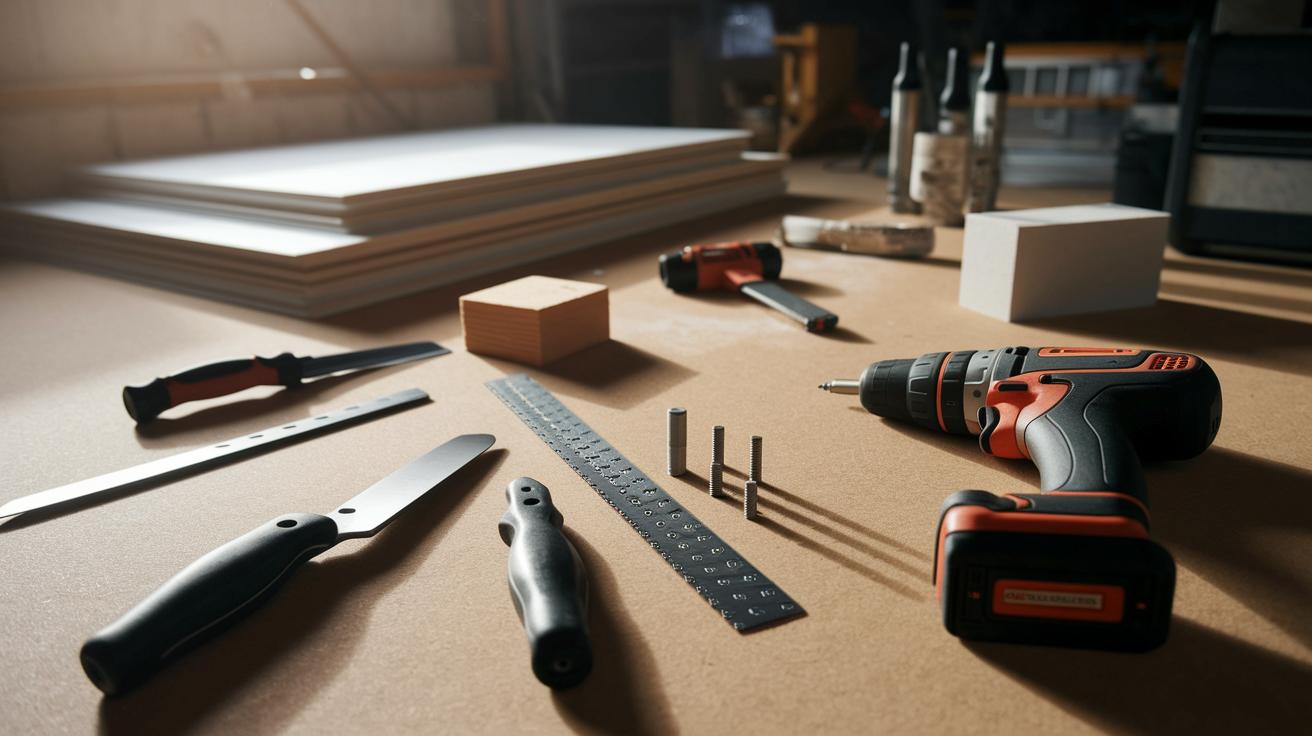
Before you begin, gather your basic hand and power tools. You’ll need a sharp utility knife to score the drywall, and a T-square (or drywall square) to help make straight cuts. For more detailed cuts, use a spiral saw or jab saw. A cordless drill or screw gun with drywall screw setter bits lets you drive 1¼ in (32 mm) screws with ease. Round out your toolkit with taping knives, tools for setting corner beads, and either a sanding block or pole sander.
Next, pick the right materials for your project. Drywall panels typically come in ½ in (12.7 mm) or ⅝ in (15.9 mm) gypsum. Choose a standard, moisture-resistant, or fire-rated type based on your needs. Accurate panel sizing is key whether you’re working in a small room or a larger space; for example, moisture-resistant panels work best in humid areas.
Finally, use quality fasteners and finishing accessories for a lasting result. Rely on 1¼ in drywall screws instead of nails, which only hold temporarily. Invest in a good joint compound and opt for paper or fiberglass tape to cover seams neatly. Plus, select durable metal or vinyl corner beads to keep edges sharp and stop them from shifting or cracking over time.
Layout Planning for Drywall Installation

Measure your wall at different spots. Surfaces can be uneven, so one measurement might not tell the whole story. When you check the blueprints, record every dimension and confirm that the current drywall thickness matches the new panels you plan to install. Measure both the wall’s height and width at the top, middle, and bottom. This step gives you accurate numbers and helps you avoid wasting material. For instance, if one area is a bit longer, you might need to trim the panel for a good fit.
Mark the centers of the studs and joists next. Use a level and chalk line (or digital layout tool) to draw a straight guide where your panels will align. Stud centers are typically set at 16 in (40.6 cm) on center. This spacing ensures secure fastening when you hang the panels. If you’re not certain how to locate the studs, check a trusted source on wall framing basics. A proper layout on site saves time and effort when you start cutting and hanging the drywall panels.
Hanging and Fastening Drywall Panels

When installing drywall on a ceiling, safety and precision are key. Use a portable drywall lift or a ceiling support pole (a tool that holds panels overhead) to help you mount the panel by yourself. First, raise the drywall panel with your tool and line it up with your chalk marks. Tip: nail only the four corners lightly to hold the panel temporarily so you don’t need a helper.
Once the panel is in the right spot, secure it for good by driving 1¼ in (32 mm) screws into the studs. Begin by lightly nailing the four corners, then replace the nails with screws. Place the screws at 16 in (40.6 cm) on center, starting from the middle of each stud and working out. A screw gun with drywall screw setter bits will speed up the work and give you a neat finish. With larger panels, you may want to adjust the spacing slightly to keep the panel solid.
To lessen fatigue and boost efficiency, apply adhesive beads (glue applied in lines) to the framing before hanging the drywall panel. This extra step reinforces the bond when working overhead. Support poles and portable lifts help reduce the strain on your arms and back. Quick tip: using both adhesive and mechanical fasteners creates a strong bond and prevents issues such as sagging or misaligned fasteners over time.
Taping, Mudding, and Sanding: Finishing Drywall Installation

Finishing your drywall turns a plain sheet into a sturdy wall ready for paint or texture. A clean finish not only looks neat but also helps protect the structure by keeping seams and joints strong.
Taping Techniques
Start by embedding joint tape (a paper or mesh tape used to reinforce seams) into a thin layer of joint compound. Lay the tape along the seams and press it firmly to push out any air bubbles. Then, spread a smooth coat of compound over the tape to seal it perfectly. Quick tip: smooth out any bubbles early so they don't become bumps later.
Applying Joint Compound
Next, use a taping knife to apply several coats of joint compound. Begin with a thinner mix and gradually use a richer mix as you add layers. Follow the manufacturer’s instructions and let each layer dry for about 24 hours (1 day). Between coats, smooth the seams carefully. Think of it like icing a cake, spread it thin and even to cover any flaws.
Sanding and Surface Prep
After the compound dries, use fine-grit sandpaper or a pole sander to gently smooth the surface. Sand lightly to avoid damaging the paper face of the drywall. Control the dust as much as possible since excess dust can cause problems with later finishes. Look over the wall for any small imperfections and prep it for the final coat of paint or texture. Work carefully so you leave just a touch of roughness to help the paint stick.
When you take the time to do these steps right, you create a solid base for a flawless finish, whether you’re aiming for a super-smooth Level 5 wall or a slightly textured Level 2 surface under tile.
Troubleshooting Drywall Installation: Integrated Reminders

Drywall work has many steps, and quick checks can help you avoid problems. Every step includes key reminders like cutting power first, leaving a 1/2 in (1.3 cm) gap at the bottom for expansion, and spacing screws every 16 in (41 cm) on-center. Use screws to secure the panels, add corner beads for a neat finish, and sand lightly so you don’t damage the paper surface. Always test the outlet to be sure the circuit is off before you start cutting.
If panels seem off or screws pop during assembly, review these basic steps first. Then look into less common issues like moisture or small irregularities in the framing. For instance, if the drywall sheets don’t match up, tap a level on the supports to check they are square and secure.
After each step, take a moment to check your work. This extra pause helps build a solid, long-lasting finish without having to redo basic steps.
Post-Installation Inspection and Cleanup for Drywall Projects

Start by carefully checking your drywall work. Look over every seam and joint to make sure they're smooth and even. Spot any loose fasteners and ensure the corner beads stick firmly with no gaps. If you find a blemish or weak spot, use a touch-up compound to fix it. Confirm that each joint is securely sealed before you start painting.
After the installation, control the dust and debris by opening windows or using a dust collector if you have one. Discard scrap materials and remove any loose pieces from the area. Clean your tools right away to keep them working well. Regularly check the workspace for any stray debris, which helps prevent accidents and maintains a quality finish.
Final Words
In the action, our guide walked you through measuring, hanging, taping, mudding, and troubleshooting to ensure smooth drywall installation steps. We detailed each phase, from picking the right tools and materials to laying out precise measurements and finishing corners correctly.
Keep the sequence handy as you complete your project. Follow each step and safety tip closely to build a sturdy and cost-effective wall. Enjoy the process and the rewarding outcome of a job done right.
FAQ
What does a drywall installation guide pdf provide?
The drywall installation guide pdf provides a complete visual walkthrough of measuring, cutting, hanging, and finishing drywall panels, making it easier to understand each step for a safe and accurate installation.
What are the drywall installation steps for beginners?
The drywall installation steps for beginners break down the process into clear, sequential actions: measure and cut panels, position the top sheet first, secure with nails and screws, leave a proper floor gap, and finish with taping and sanding, all of which are often illustrated with pictures.
What does a drywall installation diagram show?
The drywall installation diagram shows the layout and sequence of work, including stud marking, panel positioning, fastening locations, and finishing touches, giving a visual map for proper installation.
How are drywall installation costs determined?
The drywall installation cost is determined by factors like material prices (panels, screws, joint compound), tool rentals, room size, and whether you complete the project yourself or hire a professional.
What is the process for installing drywall and insulation?
The process for installing drywall and insulation involves first placing insulation between wall studs to improve energy efficiency, then hanging drywall panels over the studs, ensuring proper alignment and sealing gaps with joint compound.
In what order should drywall be hung?
The drywall should be hung starting with the ceiling panels, followed by the top row of wall panels, and then working downward, ensuring that joints are staggered for a structurally sound and visually appealing result.
Do you leave a gap between drywall sheets?
Yes, leaving a gap between drywall sheets is necessary to allow for expansion and proper joint treatment with tape and compound, which helps prevent buckling or cracking during temperature changes.
How many screws should you use for a 4×8 sheet of drywall?
For a 4×8 drywall sheet, screws should be placed about 8–16 inches apart along the edges and about 16 inches on center across the panel, ensuring secure attachment without over-screwing.